 ca408bbbb5
chore: Update README

* Update readme


Approved-by: Chuma Mcphoy (We Ahead)
Approved-by: Joakim Jäderberg
16 KiB
Translations
Integration with Lokalise
We use Lokalise as our third party provider for managing translations.
For most cases you should be able to just run yarn i18n:sync to sync translations between Lokalise and our apps, but it might be beneficial to understand what happens behind the scenes:
Message extraction from codebase
Extracts the messages from calls to intl.formatMessage() and other supported methods on intl across our apps and packages.
Running the following command will generate a JSON file at ./scripts/i18n/extracted.json. The format of this file is for consumption by Lokalise. This JSON file is what gets uploaded to Lokalise.
yarn i18n:extract
Checking for changes between codebase and Lokalise
Note
: Diff only considers the English language.
It is recommended to download the latest labels from Lokalise to make sure you have the latest before diffing. See below.
- Run the message extraction above.
- Run
yarn i18n:diff
Message upload to Lokalise
Set the environment variable LOKALISE_API_KEY to the API key for Lokalise in .env.local.
Running the following command will upload the JSON file, that was generated by extraction, to Lokalise.
It supports the different upload phases from Lokalise meaning that once this command completes the messages are available for translation in Lokalise.
yarn i18n:upload
Message download from Lokalise
Set the environment variable LOKALISE_API_KEY to the API key for Lokalise in .env.local.
Running the following command will download the translated assets from Lokalise to your local working copy.
DOCUMENTATION PENDING FOR FULL WORKFLOW.
yarn i18n:download
Message compilation
Compiles the assets that were downloaded from Lokalise into the dictionaries used by the codebase.
DOCUMENTATION PENDING FOR FULL WORKFLOW.
yarn i18n:compile
Message distribution
Distributes the compiled dictionaries to the apps that need them.
yarn i18n:distribute
Convenience script targets
Extract and upload: yarn i18n:push
Download, compile and distribute: yarn i18n:pull
Extract, upload, download and compile (push && pull): yarn i18n:sync
The workflow
We use the following technical stack to handle translations of UI labels.
- react-intl: Library for handling translations in the codebase.
- Lokalise: TMS (Translations Management System) for handling the translations from the editor side.
A translation is usually called a "message" in the context of i18n with react-intl.
In the codebase we use the Imperative API of react-intl. This allows us to use the same patterns and rules regardless of where we are formatting messages (JSX, data, utilities, etc). We do not use the React components of react-intl for the same reason, they would only work in JSX and would possibly differ in implementation and patterns with other parts of the code.
To define messages we primarily invoke intl.formatMessage (but intl has other methods for other purposes too!). We take care not to name the message, we do that by not passing the id attribute to formatMessage. The reason for this is that we also have implemented the @formatjs/cli and the SWC plugin. Due to the SWC plugin being a fairly new project and also due to version mismatching reasons, we are using a pinned version of the SWC plugin. Once we upgrade to Next.js 15 we can upgrade the SWC plugin too and skip pinning it. Together, these two are responsible for allowing us to extract defined messages in our codebase. This optimizes the developer workflow by freeing up developers from having to name things and to not be wary of duplicates/collisions as they will be handled by the extraction tool and Lokalise.
Example of a simple message:
const myMessage = intl.formatMessage({
  defaultMessage: "Hello from the docs!",
})
In cases where extra information is helpful to the translators, e.g. short sentences which are hard to translate without context or we are dealing with homographs (words that are spelled the same but have different meanings), we can also specify a description key in the formatMessage call. This allows the tooling to extract all the different permutations of the declared message along with their respective descriptions. The same sentence/word will show up multiple times in Lokalise with different contexts, allowing them to be translated indivudually. The description is intended to assist translators using Lokalise by providing context or additional information. The value is an object with the following structure:
description = string | {
  context?: string // natural language string providing context for translators in Lokalise (optional)
  limit?: number // character limit for the key enforced by Lokalise (optional)
  tags?: string // comma separated string (optional)
}
Examples of a homograph with different context:
const myMessage1 = intl.formatMessage({
  defaultMessage: "Book",
  description: "The action to reserve a room",
})
const myMessage2 = intl.formatMessage({
  defaultMessage: "Book",
  description: "A physical book that you can read",
})
Examples with a (contrived) sentence:
const myMessage1 = intl.formatMessage({
  defaultMessage: "He gave her a ring!",
  description: "A man used a phone to call a woman",
})
const myMessage2 = intl.formatMessage({
  defaultMessage: "He gave her a ring!",
  description: "A man gave a woman a piece of jewelry",
})
Diagram
A diagram showing the high level workflow of translations. It is currently a manual process syncing messages to and from Lokalise into the codebase.
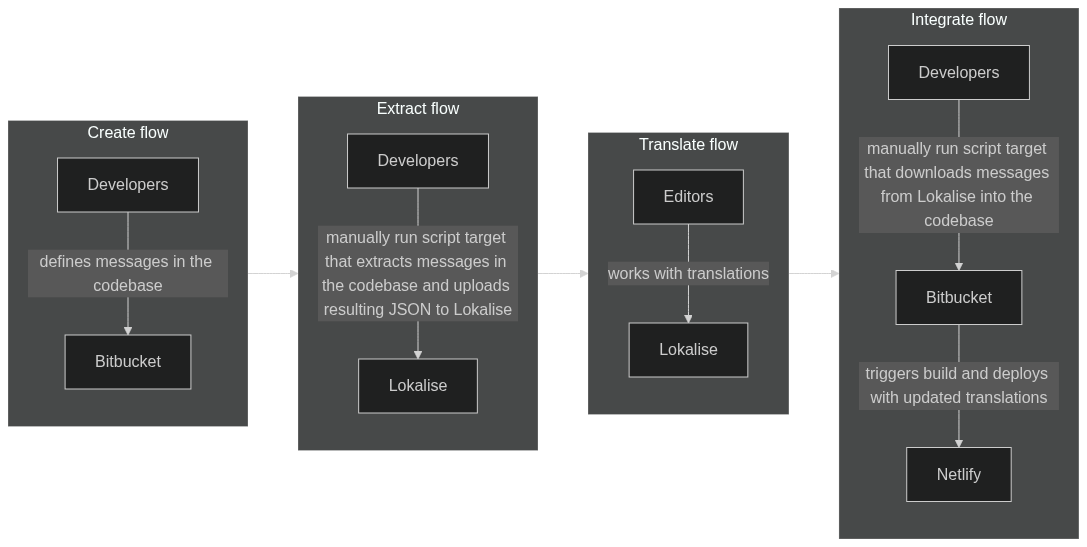
The following is a diagram showing how all the parts interact with each other. Note that interacting with Lokalise in any way does NOT trigger a build and deploy. A manual action by a developer is required to deploy the latest translations from Lokalise. (Once the manual process reaches maturity we might try and automate it)

Do's and Don'ts: How to use react-intl in the codebase
-
Do not destructure
formatMessagefrom eithergetIntl()oruseIntl().❌ Do not do this:
const { formatMessage } = useIntl()
const message = formatMessage(...)
✅ instead do this:
const intl = useIntl()
const message = intl.formatMessage(...)
❌ Do not do this:
const { formatMessage } = await getIntl()
const message = formatMessage(...)
✅ instead do this:
const intl = await getIntl() const message = intl.formatMessage(...) -
Do not pass variables as defaultMessage.
The
defaultMessageneeds to be a literal string so that the tooling can properly find and extract defined messages. Do not use template strings with variable interpolation either.❌ Do not do this:
const data = await getSomeData()
...
const message = intl.formatMessage({
  defaultMessage: data.type,
})
...
const message = intl.formatMessage({
  defaultMessage: `Certification: ${data.type}`,
})
✅ instead do this:
This is a hard one to give a general solution/rule for, but in essence it should use either use a "switch approach" or
defineMessage/defineMessages(docs) in some way.The most common reason for this scenario is that the data contains one or several words/sentences we want translated.
The preferred solution is to use a "switch approach" (or something equivalent), checking some property of the entity to decide what message to use.
- It is explicit about what cases are supported: this helps finding bugs by lowering complexity by making it easier to find where a string is used.
- The declaration is coupled with the usage: keeping our messages up to date and clutter free over time.
- The formatjs eslint plugin helps enforce proper usage.
- TypeScript will force us to keep the list up to date with the typings of
data.type. Preferably ALL data points of this manner should be an enum or an array of stringsas const(or equivalent) for the best TS support here.
...
const data = await getSomeData()
...
let message = intl.formatMessage({defaultMessage: 'N/A'})) // or some other default/"no match" message
switch (data.type) {
  case "Restaurant":
    message = intl.formatMessage({defaultMessage: "Restaurant"})
    break;
  case "Bar":
    message = intl.formatMessage({defaultMessage: "Bar"})
    break;
  case "Pool":
    message = intl.formatMessage({defaultMessage: "Pool"})
    break;
  case "Some certification":
    message = intl.formatMessage({defaultMessage: "Certification: {name}"}, { name: "Some certification"})
    break;
  default:
    // TS will throw if it reaches here if typings for `data.type` are properly defined and the above cases are exhaustive.
    // This will help us keep messages up to date.
    const type: never = data.type
    console.warn(`Unsupported type given: ${type}`)
}
If the above is not possible the escape hatch is using something like the following. Avoid using this because:
- This decouples the message declaration from the message consumption: causing stale messages to linger around and clutter up the codebase.
- It makes it a lot harder to find where a string is being used in the codebase.
- The formatjs eslint plugin is unable to enforce placeholders: this decreases confidence in our messages and potentially hiding bugs.
import { defineMessages } from "react-intl" ... const data = await getSomeData() ... const restaurantMessage = defineMessage({ defaultMessage: "Restaurant", }) const barMessage = defineMessage({ defaultMessage: "Bar", }) const poolMessage = defineMessage({ defaultMessage: "Pool", }) // OR const messages = defineMessages({ restaurant: { defaultMessage: "Restaurant", }, bar: { defaultMessage: "Bar", }, pool: { defaultMessage: "Pool", } }) ... return ( <p>{intl.formatMessage(messages.restaurant)}</p> // or .bar or .pool, etc. ) ... // Since calls to defineMessage/defineMessages get their messages extracted, // technically you can do the following instead of accessing the key like above. // But it is not encouraged as this decoupling leads to had to track usage and decay over time: const message = intl.formatMessage({ // eslint-disable-next-line formatjs/enforce-default-message defaultMessage: data.type, // data.type === "Restaurant" | "Bar" | "Pool" }) -
Do not use defaultMessage key as an alias.
The
defaultMessageshould be the actual message you want to display (and send to Lokalise). It must be written in American/US English.❌ Do not do this:
const message = intl.formatMessage({
  defaultMessage: "some.alias",
})
✅ instead do this:
const message = intl.formatMessage({ defaultMessage: "The real message is here in US English", }) -
Do not use conditionals when defining messages.
❌ Do not do this:
const message = intl.formatMessage({
  defaultMessage: someVariable ? "Variable is truthy" : "Variables i falsey",
})
✅ instead do this:
const truthyMessage = intl.formatMessage({ defaultMessage: "Variable is truthy", }) const falseyMessage = intl.formatMessage({ defaultMessage: "Variable is falsey", }) const message = someVariable ? truthyMessage : falseyMessage -
Avoid using ICU special words as placeholder names
Some words have meaning in ICU when dealing with placeholders and such. To avoid bugs and confusion do not use them as placehodler names.
Avoid (list is not exhaustive):
{number}{integer}{plural}{date}{time}{select}{choice}{other}
Also do not use the current variable name in scope as the placeholder name (unless the variable is named following the below rules). It will confuse translators.
❌ Do not do this:
const number = getValueSomeWay()
...
const message = intl.formatMessage(
  {
    defaultMessage: "The number is {number}",
  },
  {
    number,
  }
)
nor this
const goodNameForVarButNotForPlaceholder = getValueSomeWay()
...
const message = intl.formatMessage({
  defaultMessage: "The number is {goodNameForVarButNotForPlaceholder}",
}, {
  goodNameForVarButNotForPlaceholder
})
✅ instead do this:
Prefer a placeholder name that gives context to the message when reading it without the context of the code
const goodNameForVarButNotForPlaceholder = getValueSomeWay()
...
const message = intl.formatMessage(
  {
    defaultMessage: "The number is {membershipNumber}",
  },
  {
    membershipNumber: goodNameForVarButNotForPlaceholder,
  }
)
or if context is hard to give, use generic words like
value,count,amount, etc.const number = getValueSomeWay() ... const message = intl.formatMessage( { defaultMessage: "The number is {value}", }, { value: number, } ) -
Do not give id to messages.
The eslint plugin will automatically fix this (removes the id on save/fix).
❌ Do not do this:
const message = intl.formatMessage({
  id: "some-id",
  defaultMessage: "This is a message",
})
✅ instead do this:
const message = intl.formatMessage({
  defaultMessage: "This is a message",
})